Images of the past

A chronologue of beauty

Sunday, 8 April 2012

Allegorical Portraits


First portraits of contemporary people started off as something of allegories as often painters would put the faces of their patrons on the bodies of the saints that they were commissioned to portray,so called donor portraits.Later on portraiture took off allegorical portraits remained popular as it allowed artists to portray their subjects in roles,and fantastical robes,normally restricted in everyday lives.It gave the sitter attributes of Greek Goddesses,Muses,Nymphs and set them in rustic,pastoral scenes where they could pretend to be free roaming shepherdesses,gardeners and of course wearing highly idealized attire.Ladies would be able to show off far more leg,or a breast,than what would be considered decent if she wasn't in a guise of a Minerva,Flora or Cleopatra.Kings could show their might by dressing up as their favorite deity as Louis XIV did many times.His cousin Marie Anne d'Orleans La Grande Mademoiselle,who commanded soldiers in the great Fronde against him,portrayed herself many times as Minerva the Goddess of Wisdom.Actresses chose their favorite muse,particularly pious ladies dressed up as their favorite Saint and royal mistresses took liberty to show off their beautiful bodies in the guise of Venus,something which would've been scandalous had she not been in the guise of the venerable Goddess of Love.


                                      Louise of Savoy as Sibylla Agrippa,1430 Jacques Daret


Portrait of Catherina Sforza as St.Catherine,c.1475 by Sandro Boticelli


Portrait of Simonetta Vespucci as Cleopatra,1480 Piero di Cosimo


Simonetta Vespucci as Maria Lactans,c.1480 Sandro Botticelli


Portrait of a young woman as an allegory warning of foolishness and false love,1485-1500,attr. to the Master of Portraits of Princes


Lucas Paumgartner as St. Eustace,1503 Albrecht Dürer


Portrait of a Saxon noblewoman as Mary Magdalene,1525 Lucas Cranach the Elder
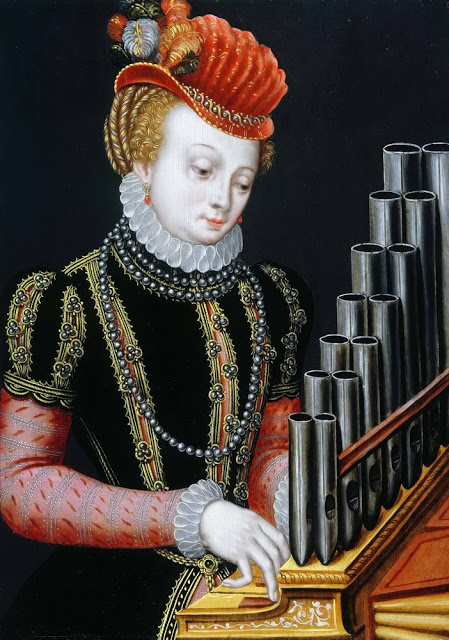
Portrait of a Lady as St. Cecilia by circle of Ambrosius Benson,1530s

Francois I of France as Mars,c. 1545

Portrait of a woman as Cleopatra,16th c


Gabrielle d'Estrees as Diana the Huntress,1590 Ambroise Dubois

                                         Gabrielle d'Estrees as Diana the Huntress,detail

Portrait of a Young Woman as Portia Catonis,c. 1600 by Santi di Tito

Portrait of a young Girl as Flora,1620s Cornelis van Poelenburch


Portrait of a Lady as Spring,c. 1620 follower of Abraham Janssens 
      
Portrait of a Lady as Saint Catherine,c.1630 Claude Deruet
         
Saskia as Flora,1636 Rembrandt


Duchesse de Monatusier as a Shepherdess,1630 Claude Duret


Marie Charlotte de La Tremoille,Duchess of Saxe Iena as Geometry,1630

Marie de Rohan,Duchesse de Chevreuse as Diana the Huntress,c.1630 Claude Deruet


Portrait of a young girl as Diana,c. 1630 by Govaert Flinck 


Portrait of a Lady as a Shepherdess,c. 1630 Claude Deruet 
      
                        Portrait of a Lady as Diana,c. 1635 Henri Beaubrun or Claude Deruet
                                
Christine Marie de France,Duchesse de Savoie as Minerva with her son  Francesco Hyacinte


Marie Christine de France as Minerva,c. 1640 Charles Dauphin

Portrait of a woman as Diana,1640s Ferdinad Bol

Young Lady as Diana,c.1640 Joseph Werner the Elder

Portrait of a lady, full-length, as Diana, in a rocky landscape, identified as being by Joseph Werner the Younger

Anne Marie Louise d'Orleans Grande Mademoiselle as Minerva,c.1640

Young Louis XIV as Jupiter,c.1645 

Henriette von Nassau as Diana,c.1640 Willem van Honthorst

Lady as Diana,c.1650 Jan van Mijtens


Two Ladies as Shepherdesses,c. 1650 Gerard van Honthorst
            
Anne Marie d'Orleans La Grande Mademoiselle as Minerva,c.1650


Portrait of a lady as Diana by Charles Beaubrun c.1650

Lady as Minerva,c. 1650 Charles Beaubrun

 Laura Mancini as Minerva,1650s

Marie Anne Mancini as Diana the Huntress,1654 Juste d'Egmont

Portrait of Molliere as Julius Cesar,1658 Mignard

Portrait of a Lady as Mary Magdalene,c.1660 circle of Ferdinand Bol

Margaret Yolande of Savoy,Duchess of Parma as Minerva,c.1660

Portrait of a boy as Cupid,1660 Nicoales Maes

Marie Therese,Queen of France as  as patron of the Cathedral of Notre-Dame de Paris,
c.1660 Charles Beaubrun
  
Lady as Diana the Huntress,c. 1660 Jacob Huysmans

Portrait of Vincenzo Ferdinando Ranuzzi as Amor,1663 Elisabetta Sirani

Anne Crane Lady Belasyse as a Shepherdess,c.1660
                
William III as Mars,1668 Jan de Baen
           
Madame Lagley as Minerva,c.1660 Mignard 

Henriette Anne d'Orleans as Minerva,c.1660

Honorine d’Ursel by Justus van Egmont,c.1665-70

Claudia Felicitas of Austria as Diana,1666 Giovanni Maria Morandi


Louise de la Valliere as St. Helena by a follower of Abraham Janssens,c. 1660s

Henriette Adelaide of Savoy,Electress of Bavaria in armour,1670

Lisolotte von der Pfaltz as Diana,1670

Portrait of Victoria della Rovere as St. Vittoria,1673 Mario Ballasi

James Duke of York as Mars,1673 Sir Peter Lely

Portrait of a girl as a Shepherdess,1670 Karel Skreta

Portrait of a boy as St.George,c.1670 Karel Skreta

Portrait of Mue Mertain as Minerva,c.1670s Mignard

Frances Theresa Stuart,Duchess of Richmond as Minerva,1675 Henri Gascar
            
Portrait of a Lady as Minerva, 1679 by Joseph Wright 

Elisabeth Charlotte d'Orleans as Diana,c.1680

La Grande Mademoiselle as Athena,c.1680

Elizabeth Washington,Lady Ferrers as Minerva after Michael Wright, 1670s

Portrait of a young Lady as Flora,1685-90 Jan van Haesbergen

Anna Maria Luisa de Medici as Minerva by Jan Frans van Douven,c. 1700

Portrait of a noblewoman as Cleopatra,c. 1700 Pierre Gobert

Marquise de Gueydan as Hebe,1730 Largilliere

Portrait of a Woman as Minerva by Jean Raoux,1730

Charles William Frederick, Margrave of Brandenburg-Ansbach dressed as shepherd,c.1740

 Portrait of a Lady as a Shepherdess by an unknown British artist,1740-55
                                              
Portrait of Madame Henriette de France as a Vestal Virgin,1749 Nattier

Duchesse de la Rochefoucauld as Hebe,c.1750 Jean-Marc Nattier

Madame Boucher as a Shepherdess,c.1760 Studio of Boucher

Elizabeth Cust,Mrs Yorke as a Shepherdess,1760s Francis Cotes

Medallion with a Portrait of Catherine the Great of Russia as Minerva,1762

Lady Anne Dawson as Diana,1763 Joshua Reynolds

Anne Dashwood,Countess Galloway as a Shepherdess,1764 Reynolds

Luise Henriette Wilhelmine von Anhalt-Dessau as Diana,1765 Charles van Loo

Madame Berger as La Belle Jardiniere,1766 Boucher

Sarah Harrop as a Muse,1780-81 Angelica Kauffman

Louise Henrietta Campbell,Lady Scarlett as the Muse of Literature by 
Angelica Kauffman,1780s

Portrait of I. J. Jakimov as Amur,c.1790 Argunov

                   Duchesse de Choiseul as La Belle Jardiniere,c.1790 Jeanne Philliberte Ledoux
                                                                                     
Portrait of a Caroline Anne Brudedenell as a shepherdess,c.1790 Mary Hoare     
                                                                         
Lady Loft as Hebe,c.1790 Hugh Douglas Hamilton

Portrait Of Mademoiselle Guimard As Terpsichore,1799 Jacques-Louis David


Portrait of the Marquise d'Hervey Saint-Denys by Raimundo Madrazo,1885


Friday, 6 April 2012

Ladies of the Night : La Cortigana Onesta


When royal marriage was made for political reasons and future spouses laid eyes on each other for the first time on their wedding days the results were often disappointing.The lady in question did not have much choice and passed her life in embroidery,charity and gossip.The lord on the other side had plenty of ladies willing to satisfy his every need.But when physical needs were satisfied he needed other kinds of stimulation,the mental kind,so the perfect woman was one who knew how to do both,satisfy the flesh and then carry on a conversation on any topic,conversing confidently on politics,poetry,hunting and intertwining it  with a bit of gossip.This was a job for the courtesan a woman brought up,educated and skilled in the arts of pleasing a man.The Venetian cortigiana onesta was a worldly woman,more educated than the noblewomen of the time and usually with a career as a performing artist aside from being a courtesan.The played music wrote poetry,prose,sang and usually had more liberty than any other woman at the time since they had the right to collect keep and manage the money they earned.Some amassed fabulous wealth and could not be visually separated form the best noblewoman their lavish dress forcing the authorities to pass many sumptuary laws which were never observed.They were the supermodels of the day wearing the latest in fashion,their rich daring and inventive  outfits becoming the latest trends and must haves which every woman that could afford the luxury soon clamored to copy.The public's fascination with the courtesan was immense and their adventures successes and lives were told and retold in great detail.The courtesan survived well into the twentieth century and some form of it even goes on to this day.


Two Venetian Courtesans,c. 1495 Vittore Carpaccio

Detail of a Courtesan from "The Prodigious Son with Courtesans",16th c. Flemish painting

Four Courtesans and Three Gentlemen,1519 Giovanni Cariani

   Courtesan Playing a Lute,1570 Michiel Parrhasio

A Venetian Courtesan, Seated, with a Clock by an artist of the English school,16th c.

Portrait of a Courtesan,c. 1600 Tintoretto

Courtesan with a Fan,c1650-60 Girolamo Forabosco 

Venetian Courtesan, c1650-60 Girolamo Forabosco


Ninon de l'Enclos was the great French courtesan of the seventeenth century.Beside being a lover of some great men like great Prince de Conde,Gaston de Coligny and the Duc de La Rochefoucauld she had in hand in the careers of two great men of literatute,Molliere whose early careen she supported and Voltaire,the son of her accountant,to whom she letf money in her will for future education.Her popularity was such that the most powerful man in France at the time the Cardinal de Richeleu offered fifty thousand crowns,a stupendous sum,to spend a night on her bed.Ninon took the money and sent a friend in her place.She presided over a salon at which the greatest minds of the time converged to exchange and discuss ideas.Her views on religion landed her in prison on behalf of the King's mother Anne of Austria a woman known for her piety.Afet her stay in prison she gave up her courtesan lifestyle and died at age eighty two a very wealthy woman.

Ninon de l'Enclos,Pierre Mignard

Ninon de l'Enclos,Henri Gascard


Sophia Baddeley was and English courtesan who was also a famous actress and a singer.At the height of her success as an actress on Drury Lane theaters and after separating from her husband  she discovered that she could support herself by becoming a companion to wealthy and powerful men and established herself as a courtesan.Her beauty and extravagant lifestyle were famous throughout England and the public craved any information on her life.But her extravagance and bad management of her finances was her ruin and she took refuge form creditors by escaping to Dublin form where she fled to Edinburgh in Scotland.With her beauty and health failing she lost most of her benefactors and was forced to return to the stage and she died aged forty five in very impoverished curcumstances.

                                                                 Sophia Baddeley


Kitty Fisher was a muse to Joshua Reynolds and he painted many charming portraits of the famed courtesan recording for posterity her celebrated beauty,her charm and promoting her reputation.She had a flair for publicity and became famous for her affairs with many men of wealth.Her dress and appearance were copied,the newspapers of the day recorded and scrutinized her every move and satires on her life were published broadly.When Giacomo Casanova visited England he met the famous lady and wrote: "..the illustrious Kitty Fisher was just begging to be fashionable.She was magnificently dressed,and it is no exaggeration to say that she had on diamond worth five hundred thousand francs.Goudar told me that if I liked i might have her then and there for ten guineas.I did not care to do so,however,for,though charming,she could only speak English,and I like all my senses including that of hearing,gratified.When she had gone Mrs. Wells told us that Kitty had eaten a bank note for a thousand guineas,on a slice of bread and butter,that very day.The note was a present form Sir Atkins,brother of the fair Mrs Pitt.I do not know whether the bank thanked Kitty for the present she had made it."Kitty achieved the dream of every courtesan by marrying one of her benefactors thus becoming a respectable woman.Sadly she died a few months after her marriage,at a young age and was buried in her best ball gown.

                                    
Kitty Fisher,Francis Cotes

Kitty Fisher,1763-4 Reynolds


The Georgian era singer Martha Ray came to the attentions of her father's,a famous corsetmaker,patrons due to her good looks,intelligence and great voice.After many wealthy patrons she became the mistress of John Montagy,Earl of Sandwich at age seventeen.The Earl's wife had a mental illness so Martha became something like a wife,they acted as a couple in public and she bore him seven children.He helped to finance her studies,financially supported her early singing career,also he established for her a house at Westminster to stay in when she did not want to stay at his home and gave her a generous allowance.During this time she met a soldier named James Hackman who proposed to marry her but despite a brief flirtation Martha refused the offer.He became obsessed with her suspecting that she had taken a new lover,the Baron Coleraine,he followed her to the Royal Opera House,where she had gone with a friend to see a performance ,and murdered her that night.The Earl of Sandwich was devastated by the death of his beloved mistress and James Hackman was hanged for the murder.

Marta Ray,1777 Nathaniel Dance


Grace Dalrymple was married very early to a rich physician but after a scandal she fled and ended up in Egland thanks to her benefactor Lord Cholmondery.She took many other patrons among whom the Prince of Wales future George IV who in turn introduced her to the Duc d'Orleans.Grace moved to Paris to be near her royal lover where she remained throughout the Revolution.Her lover supported the Revolution but Grace was a fervent Royalist.Her symphaties were well known and she was imprisoned by the Revolutionary goverment to await execution.She shared her cell with Madame du Barry who was executed but Grace narrowly escaped death and was freed at the end of the Reign of Terror.After her release she became a courtesan to Napoleon who even offered her marriage which Grace refused.She ended her days at Ville d'Avray,the mistress of the local mayor and a very wealthy woman.

Grace Elliot Dalrymple,1778 Gainsborough

Grace Elliot Dalrymple,1778 Gainsborough


Elizabeth Armistead was a courtesan and later a spouse of Charles James Fox a popular statesman and politician.Their relationship and later their marriage was a subject for a lot of gossip and was the most famous and controversial of their age.She began her career in a high class brothel where she met the Earl of Bolingbroke who came in the company of Charles James Fox,her future husband.The Earl was smitten and soon took her out of the brothel and made her his mistress.He thought she would do well on stage and used his influence to get her some parts.While the critics were not impressed with her acting they all praised her figure and voice.While a mistress of the Earl she met many of his friends who were impressed by her beauty and gentle nature.She took other rich lovers and in 1776 Town and Country magazine claimed that she could "claim the conquest of two ducal coronets,a marquis fur earls and a viscount".Among her other lovers were the Duke of Dorset and the Prince of Wales and after a decade of platonic friendship she and Charles Fox became lovers.They moved into a house together and she stopped seeing other men settling for a quiet life with her lover.When one day she heard a very rich and influential gentleman offer Charles Fox his daughter's hand in marriage she offered to get out of his life.He would not hear of it and to assuage her fears offered to marry her.They were married in a secret marriage in 1795 but the marriage was made public in 1802 when they traveled together to France where he was to be honored by Napoleon.Their marriage scandalized polite society but after the initial shock Mrs Fox was generally accepted by all.They had little time to enjoy this life as Fox grew ill with dropsy and died in 1806.She lived mourned him greatly and spent her days as a statesman's respected widow.

Elizabeth Armistead


The Irish comic actress Dorothy Jordan became famous as the actress with the most beautiful legs ever seen on stage.She loved showing them off by taking on "breeches roles" or male parts where she would dress up in men's attire.One contemporary left this description "Her face,if not exactly beautiful,was irresistibly agreeable,her person and gait were eminently elastic;her voice in singing perfectly sweet and melodious,and in speaking clear and impressive". She had affairs with many actors,noblemen and wealthy patrons before meeting the man that she would devote most of her life to,the Duke of Clarence future King William IV.A paper announced that she yielded to the Prince's advances for the sum of  three thousand pounds before consummation and one thousand pounds a year.She would bear him at least ten children during twenty years together and would act as his wife soon enough she even started supporting the free spending Duke who had a meager allowance for his father the King and soon collected her earnings for himself.As she dashed around  England in an effort to support them the Duke looked around for a suitable lady to marry.Thinking that his relationship with her had harmed his prospects of marriage to a twenty two year old heiress he told her that they must part.Dorothy was left alone and in failing health she was unable to pay her creditors.She was forced to flee to France where she lived in a hope that her lover and children will remember her and write her a letter with an invitation to return to England.One day when the post failed yet again to deliver the letter Dorothy collapsed and died.She was buried in a simple grave provided by a charity of friends.

                                                     Dorothy Jordan,1791 John Hoppner


Dorothy Jordan,John Hoppner


Emma Hamilton is one of the most celebrated courtesans immortalized in paintings by Reynolds,Elizabeth Vigee Le Brun and other leading portraitists of her day.She started as a maid to the actresses on Drury Lane but soon had her own carer as a dancer.Her beauty caught the eye of men and she became a mistress of many wealthy gentlemen and nobles,even succeeding in marrying one of them,Sir William Hamilton,the English Envoy to Naples,becoming Lady Ambassadress Emma Hamilton.But her most enduring and famous romance would be with the English naval hero Lord Admiral Nelson.When Hamilton visited Naples and  was was welcomed by Emma and Lord Hamilton he was already a living legend.Emma was star struck,flinging herself in his arms she promptly fainted.We presume he was flattered by the adulation of the beautiful lady and soon as she nursed him through his illness they fell in love.Their love affair was tolerated and even encouraged by the elderly Lord Hamilton.When the three of them returned to England they continued living together in a menage-a-trois in an open way prompting the Admiralty to send Nelson back to sea in an effort to get him away form Emma.Before this could happen Emma got pregnant and bore Nelson a daughter named Horatia after her father.later that year Nelson bought a house into which he moved Emma,their daughter and her husband.This arrangement fascinated the public to no end and their coming and goings were reported in the papers with the public looking to Emma to set standards for fashion,home decoration and even dinner party menus.After a while her husband passed away and soon Nelson also left to fight in the Napoleonic wars leaving Emma pregnant with his second child.The child  died soon after birth but worse was to come for Emma with the news of Nelson's death after a famous victory.After she had spent all she has left from her husband and lover she spent some time with her daughter in debtor's prison despite instructions form Nelson that the government should provide for them due to his status as a national hero.After prison Emma turned to drink and died in Calais in relative poverty.

Emma Lady Hamilton as an Ambassadress,George Romney

Emma Hamilton,1800 Johann Heinrich Schmidt


Zofia Potocka started as a Turkish slave sold by her mother to the Polish Ambassador to Turkey who made her his mistress.After their affair ended she set herself up as a prostitute and met her future husband,the Polish Commander Jozef Witt.After bearing him two sons he sent her to Paris to be polished in cultured society.She was a great success,her beauty making her famous and desired by wealthy men among whom the King's brothers Charles Duc d'Artois and the Comte de Provence.At the outbreak of the Russo-Turkish war at her husband's posting on the Russian front she met Grygory Potemkin,Catherine the Great's favorite,and soon became his mistress,a relationship throughout his lifetime.Potemkin made her husband Governor of Cherson and used her as an agent among the Poles and the Turks since her sister was married to the Pasha of Chotin.She was introduced as Potemkin's official mistress in Saint Petersburg  after the war but was sent away from the Russian court after his death.Returnig to Poland and after her husband's death she married the Polish nobleman Stanislaw Potocki.They had eight children and she also had many illegitimate children and affairs including one with her stepson.After her husband's death she ended the affair and devoted the rest of her life to her children.


Zofia Potocka,1790 Lampi


Rosalie Duthe the celebrated French courtesan to royals and nobles has been called"the first officially recorded dumb blonde in history".She started her career after leaving a convent by apparently "ruining" the wealthy English financier George Wyndham,the Earl of Egremont.She then became a dancer on the Paris Opera Ballet and a companion to various noblemen as the Duc de Dufort,the Marquis de Genlis and the young Duc d'Artois,future King Charles X of France.In 1788 Louis Phillipe Duc d'Orleans presented her to his son Phillipe and told him to learn some facts of life from the experienced lady.Soon she was seen riding in his carriage,a privilege reserved only for royal ladies to which some nobles took offence and so composed a little song which roughly translates to "Duthe must have sucked royally".She developed a habit of pausing before speaking as if searching for words every few sentences thus inspiring many dumb jokes.But her beautiful face was much admired and she was painted by famous artists of the day like Vigee Le Brun,Dunloux,Perregaux,Lemoine and Fragonard among others.

Rosalie Duthe,1780s Schall

Rosalie Duthe,1792 Danloux

Rosalie Duthe


La Belle Otero began her life in Spain where she worked as a maid as a young girl.After being raped at age fourteen she left home with a boyfriend and became a dancer and performer.In 1888 she found a rich patron who moved her to France in order to promote her dancing career.She soon became the talk of Paris and the mistress of the most powerful men of the day like Prince Albert I of Monaco,King Edward VIII of England,the Duke of Westminster,the Kings of Serbia Spain and numerous Grand Dukes of Russia.Her love affairs made her infamous and the subject of jealousy from many notable female personalities of the day.Six men reportedly committed suicide after she dropped them and at least one duel was fought in her name.She was a confident woman with a great figure and great intelligence.She wore extravagant outfits one of them consisting of many jewels glued on to her ample bare bosom.Having retired after WWI with an impressive fortune she proceeded to gamble it away and live lavishly.She progressively squandered her money away until one day she died in a one bedroom hotel room.

La Belle Ottero

La Belle Otero,1910 Leo Rauth

La Belle Otero in costume


Ginette Latelme at fourteen was a main attraction at her mother's brothel but soon due to her patron's influence she appeared in the movies.Theatregoers were titillated by her reputation of love affairs with women as much as men.She soon became the mistress of one of France's wealthiest men Alfred Edwards a magnate of the French press.His wife was extremely jealous of her husband's mistress and wrote in her memoirs that she had "...contrived to get a photograph of Lantelme;it adorned my dressing table,and I made desperate efforts to look like her,dress my hair in the same way,wear the same clothes".Ginette died at age twenty four when she fell to her death from her lover's yacht.

Ginette Lantelme,1905

Ginette Lantelme,1908 Boldini

Mlle Lantelme in her motor car

Ginette Lantelme


Anita Berber was a Berlin dancer,cabaret singer and a prostitute of the Weimar period.She made her debut at age fourteen and soon broke boundaries with her performances which their androgyny and total nudity.She never drew a line where her performance ended and private life started making her whole life a stage.She could be seen often around Berlin nightspots wearing nothing but a sable fur  wrap,a silver broach full of cocaine and a monkey on her shoulder and flaunting her lesbian lovers.She was addicted to many drugs including opium and morphine as well as being an alcoholic.She died in a hotel room surrounded by empty morphine syringes and was buried in a pauper's grave.

Anita Berber

                                                                   Anita Berber,1918