Images of the past

A chronologue of beauty

Tuesday, 27 March 2012

Four Savoyard Princesses

These four Savoyard princesses came from a happy home with parents who respected and loved each other and remained close throughout their marriage.But sadly the daughters of Victor Amadeus and Maria Antonietta  were never to experience and enjoy their kind of marital happiness.The two eldest daughters,Marie Josephine and Marie Therese made very advantageous marriages to two princes of the house of Bourbon,brothers of the next King Louis XVI,the Comtes de Provence and d'Artois respectively.The younger two,Maria Anna and Maria Carolina married less exalted men but did not even get the compensation of a quiet life with a loving husband and many children.

                               
Victor Amadeus of Sardinia,1734

Victor Amadeus in 1740 by Guiseppe Dupra

Victor Amadeus III  of Sardinia

Maria Antonietta of Spain,1748

Maria Antonietta Queen of Sardinia in 1750 by Jacopo Amigioni

Maria Antonietta Queen of Sardinia in1755 by Guiseppe Dupra

Family of Victor Amadeus in 1759 by Guiseppe Dupra,on far left Marie Josephine,
Marie Therese and Maria Anna on right.

Marie Josephine of Sardinia as a little girl by Guiseppe Dupra ,c. 1760 

Marie Josephine left Savoy for the glittering court of Versailles as a seventeen year old girl and became the Comtesse de Provence wife of the King's grandson and brother of the Dauphin.Her wedding was followed by a luxurious ball and her husband proclaimed himself satisfied after the wedding night but the bride was found lacking in charms by the superficial French court.She was considered ugly,her complexion too dark,her eyebrows too thick.Moreover she did not have a habit for bathing and keeping clean,a fact noted by couple of courtiers,she even refused to wear powder and rouge to beautify herself which was considered an even bigger sin than being ugly.The matters were so serious that her husband had to intervene with her on the matter of rouge,thereby she consented to wear it.The couple got along well and loved to gossip about,especially Marie Antoinette inventing ludicrous stories which were often believed.

Marie Josephine de Savoie as a Nymph of the Hunt,c. 1770 by Jean Germain Drouais

Comtesse de Provence,c. 1770 by Joseph Duplessis

Marie Josephe de Savoie Comtesse de Provence,1775 by Jean-Baptiste d'Agoty

Comtesse de Provence,detail

Comtesse de Provence,1782 by Elisabeth Vigee Le Brun

Madame de Provence,18th c. engraving

Madame la Comtesse de Provence in court dress,c. 1780

Marie Josephine Comtesse de Provence,c. 1780 by Rosalie Filleul

Louis Stanislas Comte de Provence,1760 by Maurice Quentin de La Tour

Comte de Provence,1770 by Carle van Loo

The couple did not have children and the Comte soon stopped visiting his wife's bed,possibly on account of her lack of hygiene.Marie Josephine was ignored by the court now headed by a Queen with whom she had never made friends and about whom she had spread vicious rumors.She took to drink and became an alcoholic.She entered into a passionate affair with Madame de Gourbillion which was to last a lifetime.When the Comte and Comtesse left for exile on the eve of the Revolution they went their separate ways and she lived undisturbed with her beloved until circumstances made her the Queen of France.When her husband recalled her to join him in Mitau she brought along her lover.Madame de Gourbillion was forcibly removed from the carriage in which they have arrived.Marie Josephine refused to change out of her clothes and locked herself in her room with a bottle of drink refusing to come out until de Gourbillion joined her.After a while tempers calmed down but it did not last long and Marie Josephine left her husband's side once again.When they were recalled to France as King and Queen the Comte now Louis XVIII was forced to buy his wife's incriminating correspondence with her paramour.She was not Queen for long and after a second exile she died from dropsy in England.

\
Marie Therese of Savoy as a little girl,c. 1760

Marie Therese de Savoie Comtesse d'Artois

Marie Therese joined her sister in France two years later marrying the youngest grandson of the King the handsome Comte d'Artois.She fared a little bit better than her sister in the looks department and had a clear complexion which was admired at the court although not as much as Marie Antoinette's.She also took better care of herself and unlike her sister washed and cleaned her body and her teeth.She was a dull girl and the Comte de Mercy-Argentau writing to Maria Theresa in Austria said that she was "silent and interested in absolutely nothing.She caused Marie Antoinette much grief when she was the first of the wives to give birth to an heir a healthy baby boy who was followed by a sister and then a brother.Despite giving the people the much wanted heir she was despised at court and after the Queen she and her husband were the most hated  people in France due to their perceived extravagance and arrogance,which was mostly on part of her husband.

Comtesse d'Artois,1775 by Jean-Baptiste d'Agoty

Marie Therese,1780 by Perin Salbreux

Comtesse d'Artois,1780 engraving by Auguste Brun

Comtesse d'Artois in court dress,c. 1780

Comtesse d"Artois and her children,1783 by Charles Emanuel Leclerq
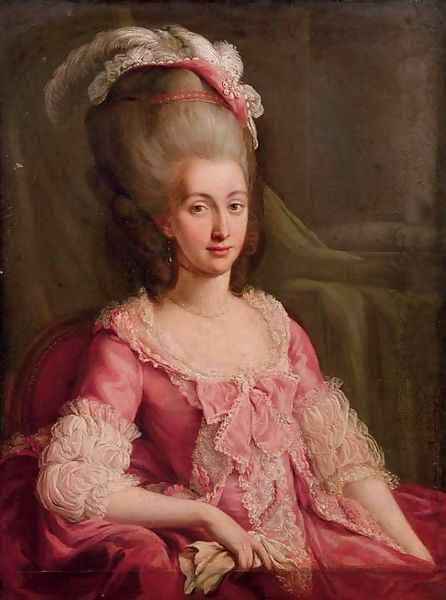
Portrait of Comtesse d'Artois,French School

Marie Therese,1790 by Alexander Kucharsky

Comtesse d'Artois,c 1790 by Joseph Boze

The Royal family of France in 1782,sitting on left Comtesse d'Artois with her children behind,Comte d'Artois standing behind his brother Louis XVI,Marie Antoinette holding the Dauphin,Madame Therese on floor,Madame Elizabeth standing behind the Queen and Comte and Comtesse de Provence standing behind

Charles Phillipe Comte d'Artois,1773 by Jean Marital Fredou

Comte d'Artois,c. 1775

Charles Phillipe d'Artois,1793 by Henri-Pierre Danloux

Comte d'Artois as King Charles X,c. 1800 by Jean Horace Vernet

Charles X,1825 by Thomas Lawrence

Children of Comte and Comtesse d'Artois Charles Ferdinand Duc du Berry,
Sophie d'Artois and Louis Antoine Duc d'Angouleme ,1781 by Rosalie Filleul

Duc d'Angouleme,1785 by Joseph Boze

Louis Antoine Duc d'Angouleme,1796 by Henri-Pierre Danloux

Duc d'Angouleme,c. 1830 by Danloux

Charles Fredinand Duc du Berry,c. 1780

Duc de Berry,1796 by Danloux

Marie Therese followed her husband in exile to England but soon left for her native Savoy due to the estrangement form her husband who found her repulsing and even forbade her from attending her son's marriage to Marie Antoinette's daughter Marie Therese.She died in exile in 1805 dying some 20 years before her husband took the throne as Charles X thereby never becoming Queen of France.


Maria Anna of Savoy,Duchess of Chablais,1777

Benedetto,Duke of Chablais

Maria Anna of Savoy,sister of Marie Josephine and Marie Therese was married to her uncle Benedetto Duke of Chablais ,her father's half brother.Strangely she was to have the happiest marriage of all her sisters despite being in a niece-uncle relationship.The couple were close and respectful of each other but his bride always saw him as her uncle thereby preventing any passionate feelings that may have developed.The couple  were unable to have children and after her husband's death she lived a long life as a widow.


Maria Carolina of Savoy,1781

Maria Carolina,Electoral Princess of Saxony,1782

Crown Prince Antony of Saxony,1827 by C.Vogel

The youngest of the Savoyard sisters was not happy about her proposed marriage to Prince Anthony of Saxony but despite her pleas was sent off to Saxony in September of 1781.Her family traveled with her for a good part of the trip but when time came for her to leave the family carriage and continue on her own the poor Princes had to be pushed out by force.Even though she was one the highest ranking females at the court in Dresden after her sister in law she was deeply unhappy and passed away form smallpox in 1782 barely a year after her arrival.


Sunday, 25 March 2012

Turquerie in Portrait Painting

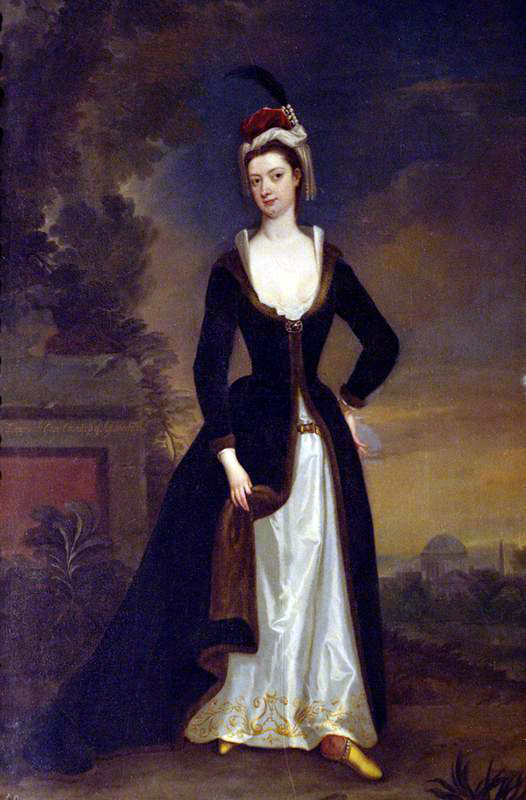
Turquerie-the fashion for all things Turkish started in e late sixteenth century and lasted well into the nineteenth.It wasn't concerned with the realities of life in the east but it was rather a product of European fantasies about the luxuries of the Orient.Turkey was a supplier of exotic goods such as coffee,perfumes,spices and tea.First diplomatic relations with the far east started near the end of the sixteenth century with Sir Robert Shirley going to Persia in 1599 in order to train the Persian army in the ways of English military warfare,where he met his wife a Circassian lady named Theresa,and Louis XIV receiving the first Persian ambassadors to France in 1715.European ambassadors often returned with exotic tales of opulent wealth,mysterious customs and quaint,strange fashions.No doubt male fantasies were flamed by descriptions of the sultan's harems,full of nubile young women ready to cater to any wish and fantasy.


Portrait of Caterina Cornaro,Queen of Cyprus by Titian,1542

Another version of the portrait of Caterina Cornaro

Portrait of a Lady in Oriental Dress by Tintoretto,c. 1560

Portrait of Lady Shirley,1622 by Anthony van Dyck

Portrait of Robert Shirley,1622 by Anthony van Dyck


Portrait of Robert Shirley and his Circassian wife Theresia,c1625
                                               
    
Margrave Ludwig Wilhelm,c1680


Lady Mary Wortley Montagy was instrumental in the popularization and the interest in the ways of the Orient.In 1716 when Edward Wortley Montagu was appointed Ambassador to Constantinopole his wife Mary went withy him.The story of their voyage and her observations of life in the city was described in her letters which were published as "Letters from Turkey".The accounts of daily life customs and manners were described in a lively manner and graphic detail and helped shape the way Europeans interpreted Turkish fashion and dressHer opinion of the Orient was very biased however,her aristocratic rank and her position as the governess of the son of Ishamel Pasha guaranteeing that she only saw the most privileged and attractive ways of the Turks.She also brought with her the knowledge of Ottoman inoculation against smallpox known as variolation where the patient was infected with a small amount of the virus thereby becoming immune to the disease.Most of the time it was successful but sometimes it brought on the disease in full form and the patient died as was the case with Empress Maria Theresa's daughter Maria Johanna Gabriela.

                   
Lady Mary Wortley Montagu

Lady Mary Montagy and her son,1717 by Jean-Baptiste van Moor

Mary Montagy and her son,detail
  
Lady Mary Wortley Montagu

Lady Mary Montagu by George Knapton


Dorothy Lady Townshend,1717 Charles Jervas

Lady Jemima Gray by Charles Jervas,1716-20

Portrait of a Lady,1720 Charles Jervas

Mrs. Thomas Pelham  by Joseph Highmore, 1720s

                           
                                              Lady as a sultana,c 1720 Nicolas de Largielle

Lady Mary Montagu,1725 by Jonathan Richardson


Caroline Lady Holland by Hoare,c 1725

Elizabeth Howard by George Knapton,c. 1730

Madame de Pompadour at embroidery,1747 Carle van Loo

Madame de Pompadour as a sultana,1747 Carle van Loo


When Madame de Pompadour commissioned Carle van Loo in 1747 to paint a series of portraits of her as a Turkish sultana she started a craze for portrait a la turque.Even the King's daughter Madame Adelaide,who could not stand her father's official mistress and called her maman putain or mummy whore,took an inspiration from her portrait and had Liotard paint her portrait dressed in Turkish costume and reading a book on a divan.


Felicita Sartori,c. 1735 Rosalba Carriera 

John Montagu, 4th Earl of Sandwich by Joseph Highmore,1740


Marquise de Broglie,1742 by Hendrik Avercamp

Lady Ponsoby,1742 by Liotard

Portrait of a lady in Turkish dress by Aved

Young lady in Turkish costume,c. 1740 Antoine Coypel

Lady Throckmorton by George Knapton,1740-45


 Jean Ettiene Liotard the Swiss painter met Lord Ducannon in Rome in 1735 and followed him to Constantinople three years later.He was fascinated by the Orient and took to dressing up in Turkish dress which earned him the nickname of "The Turkish Painter".While in Turkey he painted many members of the European colony that was established there made up of diplomats,traders and their wives.When he returned to Europe he became a favourite of Royalty and aristocracy and painted many of them attired in rich and quite realistic Turkish clothes.


Marie Adelaide of France,1753 Liotard

French lady in Constantionople by Liotard

Portrait of Mr. Levett and Miss Glavani sitting on a Couch by Liotard

Lady in Turkish dress,Liotard

Portrait of Madmoiselle Beli in Constantinople,Liotard

Portrait of a French lady by Liotard

Portrait of madame Fremeaux in Smyrna,Liotard

Portrait of Madame Marigot in Smyrna by Liotard
                                               
Marie Charlotte Boissier,1750 Liotard

Maria Theresa and one of her daughters,c. 1750 Liotard

Maria Theresa of Austria,c. 1750 Martin van Mytens

Mary Radclyffe,1755 Francis Cotes

Marie Fel,1757 by Maurice Quentin de la Tour

Comtesse de Bonneval, 1758 by Roslin

Portrait of a lady,c. 1750 Carle van Loo

Comtesse de Vergennes by Antoine de Favray, 1760

European man in Turkish costume by Antoine Favray, second half of 18th c.

European man in Turkish costume by Antoine Favray, second half of 18th c.

Elizabeth Augusta von der Pfaltz,1760

Portrait of a fashionable lady,18th c French School

Mademoiselle de Romans,1762 Drouais

Comte de Vergennes,1766 Antoine de Favray

Queen Charlotte,c 1766

Portrait of a gentleman,c 1760 Antoine de Favray

Portrait of a family,c 1760 Antoine de Favray


When Mary Wortley Monatgu's letters were published in America in 1762 the trend for portrait a la turque traveled across the Atlantic with them.John Singleton Copley was the most prolific of the American painters in this style.His subjects were powerful and wealthy ladies who wanted to show off their position by   wrapping themselves in some Ottoman opulence and displaying the fact that they were learned women who kept up with current trends.


Portrait of a lady,Carle van Loo

Lady in blue,c. 1760

Marquise de Chauvelin,c. 1750 Greuze

Elizabeth Herbert, Countess of Pembroke and her son George,1764-67 Joshua Reynolds

Princess Amalie of Zweibrucken,c 1765

Young woman in Turkish costume by Jean-Baptiste Le Prince

Lady in Turkish dress,c 1775 Le Prince

Unknown lady,1775 by Emanuel Jacob Handmann

Lady in Turkish dress,c. 1775 Emanuel Jacob Handmann

Mademoiselle de Guimard,c. 1770 by Greuze

Mary Gunning,1770 Liotard

Lady Coventry,c 1770 Liotard

Lady Anne Somerset Countess Northampton,c. 1770 Liotard

Nancy Parsons in Turkish dress,1771 George Willison

Mrs.Unwin,c. 1770 Gainsborough

Mrs. Gage,1771 John Singleton Copley

The portrait trend kept on through the 1750s and 60s and gathered steam in the 1770s with portrait painters like Francis Cotes,Josshua Reynolds and Angelica Kauffman in particular painting many portraits of languishing ladies in long flowing robes wearing ermined capes and wide sashes around the waist.Unlike in everyday fashions of the day they wear no corsets and have entwined strands of pearls around their neck and hair some of them holding up a piece of fabric imitating a turban.Some of the braver ladies went even further in authenticity and donned pants,a garment which would've been highly unsuitable for everyday dress.


Bridget Morris by Reynolds

Alice,Countess of Shipbrook by Francis Cotes

Mrs Trecothick,1771 Joshua Reynolds

Portrait of a Lady,c 1770 after Joshua Reynolds

Mrs. Brocas by Francis Cotes

Mary Dering by Francis Cotes

Portrait of a young woman called Mrs.Sparrow,1770 Gainsborough

Two Cousins in Turkish Dress by Gabriel de Saint Aubin,1770s

Charlotte Grenville and her children by Joshua Reynolds

Lady Henderson of Fordell,1771 Angelica Kauffman

Princess Louise of Denmark dressed for a Masquerade in Turkish dress,1772

Elizabeth Myddleton,1772 Frances Cotes

Anne Seymour Damer,1773 Joshua Reynolds

Mary Bruce Duchess of Richmond,1775 after Angelica Kauffman

Mrs Robert Mayne,1776 Reynolds

The Earl of Derby and his family,c. 1777 Kauffman

Dorothy,Countess of Lisburne,c. 1777 Reynolds

Mary Wadsworth,Duchess of Kent,c 1778 Reynolds

Hester Thrale and her daughter,c1778 Reynolds

Portrait of a lady,c. 1778 Hugh Barron

Portrait of a lady in blue,c. 1778 Hugh Barron

Ann Gradiner,c. 1779 Nathaniel Hone the Elder


Louise Augusta of Denmark,c. 1780 Jens Juel

Mrs.Clavering,c. 1780 Angelica Kauffman

Mrs Jordell by Reynolds

Portrait of a lady,c. 1780

Mrs Frederick Green,c. 1780 Charles Wilson Peale

Lady in Turkish dress,c. 1780 Angelica Kauffman

Theresa Robinson Parker,c1780 Kauffman

Portrait of a lady,c. 1780 Kauffman

Lady Grantham,1780-81 by George Romney

Lady Sunderlin,1782 Reynolds

Aloysia Webber,c. 1780 Lampi the Elder

French actress Louise Contat in a role of a sultana,c. 1780

Portrait of Mrs.Baldwin seated on a divan,1782 Joshua Reynolds

Maria Carolina of Austria,1783 Angelica Kauffman

Mrs Stewart,c. 1785 Charles Wilson Peale

Dorothea von Medem Duchess of Courland,c 1785

Madame Elisabeth of France wearing a turban,1788 Labille-Guiard

Madame Elisabeth,an oval version of the above painting

In 1780s France all the rage was the robe a la turque,which was less costume like and consisted of several elements of Turkish dress,the loose,long muslin dress over which was worn a tight sleeved opened mantle buttoned with a few buttons under the breast .The waist was adorned with a wide belt and the high hair was tucked under a muslin kerchief tied and arranged to resemble a turban.

Madame de Couteulx de Molay wearing a robe a la turque,1788 Vigee Le Brun

Louise Marie Adelaide de Bourbon in a robe a la turque,c. 1789 Vigee Le Brun

Marquise de Aguessenau wearing a robe a la turque,1789 Vigee Le Bun

Kordula Potocka,1790 by Lampi the Elder 

Maria Theresa Poniatowska,1797 by Kazimir Wojniakowski

Guiseppina Grassini,1804 Vigee Le Brun

Dorothea von Medem,c. 1800

Doctor Lachaise a la turque,c. 1820 Nicolas Gosse

 Roxane in Jean-Baptiste Racine's Bajazet,attributed to Eugène Devéria

Victoria Princess Royal,c. 1830 William Essex

A lady in a turban,1835 Carbonell

Portrait of Rachel,1838 Henri Gravedon

Portrait of a girl in Turkish dress,Marie Lucas Robiquet,c. 1870

Bruce and Caroline Chichester,1849 by J Edgar Williams

Katzaryna Branicka-Potocka, 1854 Winterhalter

Almina Wertheimer, 1908 John Singer Sargent